
Kliniczna ocena średnicy kanału korzeniowego w odcinku przywierzchołkowym w zębach ze zmianami okołowierzchołkowymi i bez nich
Clinical procedure
Endodontic procedures were carried out according to well-proven clinical protocol. Briefly, all teeth were instrumented under rubber dam along a standardized access cavity following removal of caries and nonsustained restoration. If necessary the lost walls of the crown were rebuilt in order to maintain a correct reference point for the stopping point of the instruments.
A solution of 5.25% sodium hypochlorite (Niclor, Ogna, Italy) was used for irrigation.
In both groups the instrumentation process was initiated with #10 and #15 K-files (Maillefer, Switzerland) to eliminate possible interferences in the coronal and medium third of the canal with the intent not to interfere with the apical third. A #08 K-file was then applied to check apical patency.
The working length was established with an electronic apex locator (Root ZX, Morita, Japan) connected with the #08 K-file or larger if appropriate. A preflaring of the canal was conducted with a #10, #15, and #20 Mtwo NiTi rotary file (Sweden & Martina, Due Carrare, Padua, Italy) running 2 mm short of the working length.
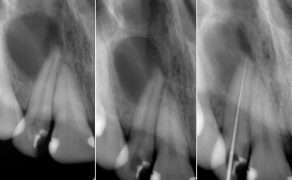
The size of the apical terminus was gauged with hand-held Light Speed LS1 files (Light Speed, San Antonio, USA) according to the following procedure. First, a thin instrument, size of #20 or larger if necessary, was inserted in the canal at the estimated working length. Successively larger [...]

którzy są subskrybentami naszego portalu.
i ciesz się dostępem do bazy merytorycznej wiedzy!