
Wyniki leczenia endodontycznego prowadzonego przez stażystów specjalizacyjnych w przychodni stomatologicznej Szpitala Bretonneau
In this study, the success rate decreases by 5% over 4 years. The success rate is 92% 1 year after completion of endodontic treatment, 90% after 2 years, 91% after 3 years, and 87% after 4 years. This result can be explained either by the failure of endodontic treatment itself or as the result of restorative and prosthetic steps and subsequent complications. It emphasizes the need for controls on the long-term healing.
Radiographic examination
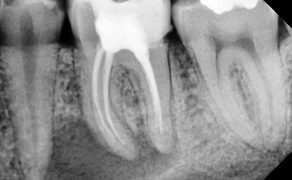
Radiographic examinations allow the evaluation of the main success criterion and the presence or absence of a radiolucent image. 2D imaging underestimates the presence and the volume of AP and this is why a PAI score = 1 was chosen as an AP free indicator [13].
Periapical lesions were scored with the PAI index [9]. The investigators can compare all the patient’s radiographs. When the 2D X-ray cannot enable us to establish a diagnosis, a CBCT is prescribed to detect the presence of an apical radiolucency. On the 6 teeth classified as „uncertain”, the CBCT examination classified 4 teeth as failure. In this study the CBCT was not used as a method evaluating the results of treatment. The number of cases involved is small and therefore statistically not significant. However, the contribution of the CBCT is crucial to the accuracy of the diagnosis and the decision making process [13] (Fig. 4). It poses, [...]

którzy są subskrybentami naszego portalu.
i ciesz się dostępem do bazy merytorycznej wiedzy!